
Noordi Journal · 28 September 2026 · 6 min read

Short answer: Move your baby from the carrycot to the seat unit once they can sit up steadily on their own. For most babies that is around six months, but anywhere from about four to nine months is normal. Until then, the flat carrycot is the right place, and if your baby outgrows it first, check the carrycot limits and the seat’s recline guidance in your pram’s manual.
There is a moment, usually somewhere in the middle of the first year, when the carrycot starts to feel small. Your baby lifts their head to look out, twists towards voices, wants to be part of the walk. It is a lovely sign, and a good time to ask whether they are ready for the seat unit. The answer depends less on the calendar than on your baby.
Why do babies start in the carrycot?
In the first months a baby cannot yet hold their own head and body upright for long, so they travel best lying flat. The NHS notes that pushchairs are only suitable for young babies if the seat reclines fully so the baby can lie flat. The Lullaby Trust describes the safest place for a baby to sleep as a clear, flat, separate space, and many first naps happen on the walk.
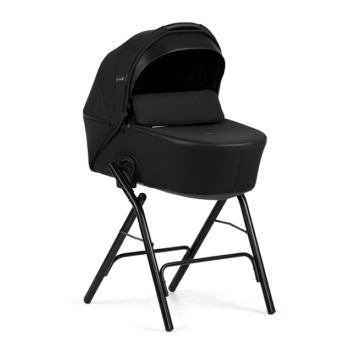
A carrycot gives exactly that: a flat, sheltered bed on wheels, with room to stretch and a hood against wind and sun.
What are the signs your baby is ready for the seat unit?
The clearest sign is sitting without support. In practice that means your baby can sit upright on their own, head steady, without leaning on their hands to stay balanced. Other signs tend to arrive around the same time:
- They hold their head and upper body steady when you carry them
- They are curious and try to lift themselves to look out of the carrycot
- Naps on the walk are shorter and they want to watch the world
- They are approaching the carrycot’s length or weight limit in your manual
Restlessness alone is not a reason to switch. Some babies simply need a new view: turning the pram towards the sea, or a slower walk under the trees, can be enough for a few more weeks.
How old are babies when they sit on their own?
The World Health Organization followed healthy children in six countries to see when they reach motor milestones. For sitting without support, the median was just under six months, and the study describes the wide window around it as normal variation among healthy children.
| Age | Babies sitting without support | What it means for the pram |
|---|---|---|
| 4.3 months | About 1 in 20 | Most still belong in the carrycot |
| 5.2 months | About 1 in 4 | Start watching for the signs |
| 5.9 months | About half | A common time to try the seat unit |
| 6.7 months | About 3 in 4 | Many families have switched |
| 8.0 months | About 19 in 20 | Nearly all babies are ready |
What if your baby outgrows the carrycot first?
Some babies are long or heavy early, and winter clothes take up room. Check the carrycot’s inner length and the maximum weight in your manual. On Noordi Aqua V.2, for example, the carrycot is rated up to 9 kg. A roomy carrycot can also buy time: both Fjordi V.2 and Aqua V.2 have 81 cm of inner length, and Fjordi’s leaves space for a winter suit.
If your baby reaches the limit before they can sit steadily, use the seat unit in its flattest position, and only if your pram’s manual says it is suitable at that age. When in doubt, ask the manufacturer before you switch.
Not a race. Just the next view.
How to make the switch gently
- Start reclined. Use the seat unit half or fully reclined for the first walks, then raise it as your baby enjoys sitting up.
- Face each other first. Many parents like to begin with the seat facing them, so the new view comes with a familiar face.
- Always use the 5-point harness, adjusted snugly over the shoulders and hips, every time.
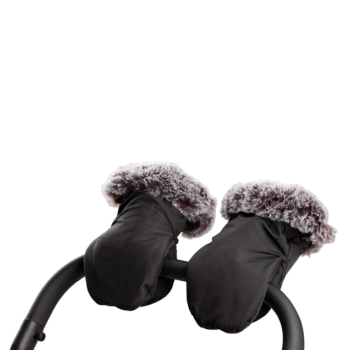
- Keep it warm. The seat is more open than the carrycot, so add a leg cover or footmuff on cool days; our guide to dressing your baby for a winter walk can help.
- Choose an easy first route. A familiar path lets you both settle into the new way of travelling.
For long sleeps, a flat surface is still best. If your baby drifts off on the walk, recline the seat, and when you are home, let them sleep lying flat.

Facing you or facing the world?
There is no single right way. Facing you makes it easy to talk, check in and share a smile; facing forward suits a curious child who wants to see where you are going. Many families switch back and forth with the mood of the day, which is one reason a reversible seat unit is worth having. You can read more in our calm checklist for choosing a pram.
Where Noordi fits
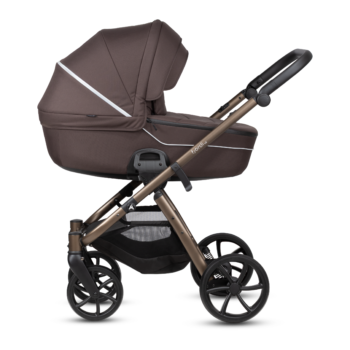
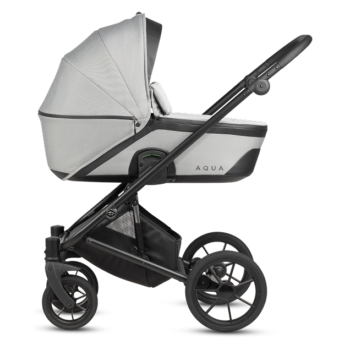
Noordi Fjordi V.2 · Aqua V.2
Both start with a flat carrycot, 81 × 37 cm inside, then click over to a seat unit certified up to 22 kg that faces you or the world. Fjordi’s seat has higher side walls, a sliding 5-point harness, a one-hand adjustable footrest and a lie-flat position of 100 × 37 cm, and it folds with the chassis either way. Aqua’s seat has an ergonomic pillow, a 5-point harness and a bumper bar.
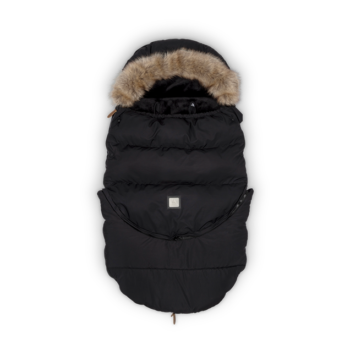
After the switch, the carrycot can still earn its place at home: the Carrycot Stand fits both carrycots, and Aqua’s carrycot can rest on the floor and rock gently. For colder months, the Winter Sleeping Bag fits the stroller and grows from 80 to 105 cm. See Fjordi V.2 and Aqua V.2.
Frequently asked questions
Can my baby use the seat unit at four months?
Only if they can already sit steadily without support and your pram’s manual allows it. Most four-month-olds are still more comfortable lying flat in the carrycot.
Can my baby nap in the seat unit?
Yes, with the seat reclined as far as the manual allows. For longer sleeps, the safest place is lying flat on their back in a clear, flat space.
My baby is eight months and not sitting yet. Should I switch?
Babies reach sitting at different times, and the WHO window stretches beyond eight months. Keep using the carrycot or a fully reclined seat, and talk to your health visitor or doctor if you are worried.
Should the seat face me or forward?
Either is fine once your child sits well. Facing you is often calmer at first; facing forward suits a curious explorer.
Do I still need the carrycot after switching?
Not on the pram, but many families keep it at home for naps on a stand, or for a second baby later.
One morning you will click the seat in, lift your baby up, and they will see the path for the first time as you do: the pines, the light, the long way home. Take that walk slowly.
Sources: WHO Motor Development Study — percentiles, WHO — Windows of achievement, NHS — What you’ll need for your baby, The Lullaby Trust — Baby sleeping products. Checked September 2026.
Made for the way you wander.
Three strollers, one calm way of getting outside. Find the one that fits your family’s days.
More from the Journal
2-in-1 vs 3-in-1 Prams (Travel Systems) Explained
What a 2-in-1 pram and a 3-in-1 travel system really include, who benefits from the car seat on the chassis, and why the carrycot is still best for longer walks.
How to Dress Your Baby for a Winter Pram Walk
Soft layers, one warm outer layer and a quick check of the chest or neck – a calm, guidance-based way to keep your baby comfortable on cold walks.

How to Choose Your First Pram: A Calm 10-Point Checklist
Ten calm questions to ask before buying your first pram, from lie-flat comfort and everyday terrain to weight, fold, car seats and the EN 1888 standard.