
Noordi Journal · 8 October 2026 · 4 min read
Short answer: Most prams sold in Europe are designed here but manufactured in Asia. A smaller group of brands still builds prams in the EU and says so openly — for example Noordi (Fjordi V.2 and Aqua V.2, made in Kaunas, Lithuania), Tutis (Lithuania) and Hartan (Germany). To be sure, look for a clear “made in” statement, not just “designed in”, and ask the brand where frames and fabrics are produced.
Families ask where a pram is made for good reasons: shorter supply chains, EU labour and environmental rules, easier repairs and spare parts, and simply knowing who built the thing your baby sleeps in. The answer is often harder to find than it should be.
“Designed in” or “made in”: why the wording matters
A brand can be European, test its prams in a European lab and still manufacture them elsewhere. Phrases like “Scandinavian design”, “Dutch brand” or “engineered in Germany” describe where the idea came from. Only “made in” or “manufactured in” describes where the pram is actually built. If a product page avoids the second phrase, it is worth asking.
Brands that state EU production
The table lists brands whose own pages, or reputable press, say where their prams are produced. It is not a complete market list — it is a starting point you can check for yourself.
| Brand | Country | What is stated | Source |
|---|---|---|---|
| Noordi | Lithuania | Fjordi V.2 and Aqua V.2 are made in Noordi’s own factory in Kaunas, where prams have been produced since 1993 | Noordi facts |
| Tutis | Lithuania | “Designed and made in Lithuania” | tutis.lt |
| Hartan | Germany | “Manufacturing at our site in Germany” | hartan.de |
| Emmaljunga | Sweden | Swedish family company founded in 1925; reported to make prams in Sweden | Utopia |
| Naturkind | Austria | Reported to be made by hand in Austria | Utopia |
For comparison, some well-known premium brands are European companies with production outside Europe. Industry press reports, for instance, that Bugaboo, headquartered in Amsterdam, operates a factory in Xiamen, China. That is not a judgement on quality — it simply shows why “European brand” and “made in Europe” are separate questions.
Five questions to ask before you buy
- Where is the frame made, and where are the fabrics sewn?
- Is the pram tested to EN 1888, and by which lab?
- Are spare parts — wheels, covers, buckles — available, and for how long?
- Who handles repairs in your country, and where are they done?
- Can the brand show the factory: photos, a video, a visit?
What does EU production change for you?
- Shorter route to your door: a pram made in Lithuania travels a few days by road to most of Europe.
- Spare parts and repairs: it is usually easier to get a part from a factory a few countries away.
- Clear responsibility: the people who designed the pram are close to the people who build it, so quality questions get answered faster.
- Your rights stay the same: wherever a pram is made, buying from an EU seller gives you at least the two-year legal guarantee.
Made in Kaunas, Lithuania
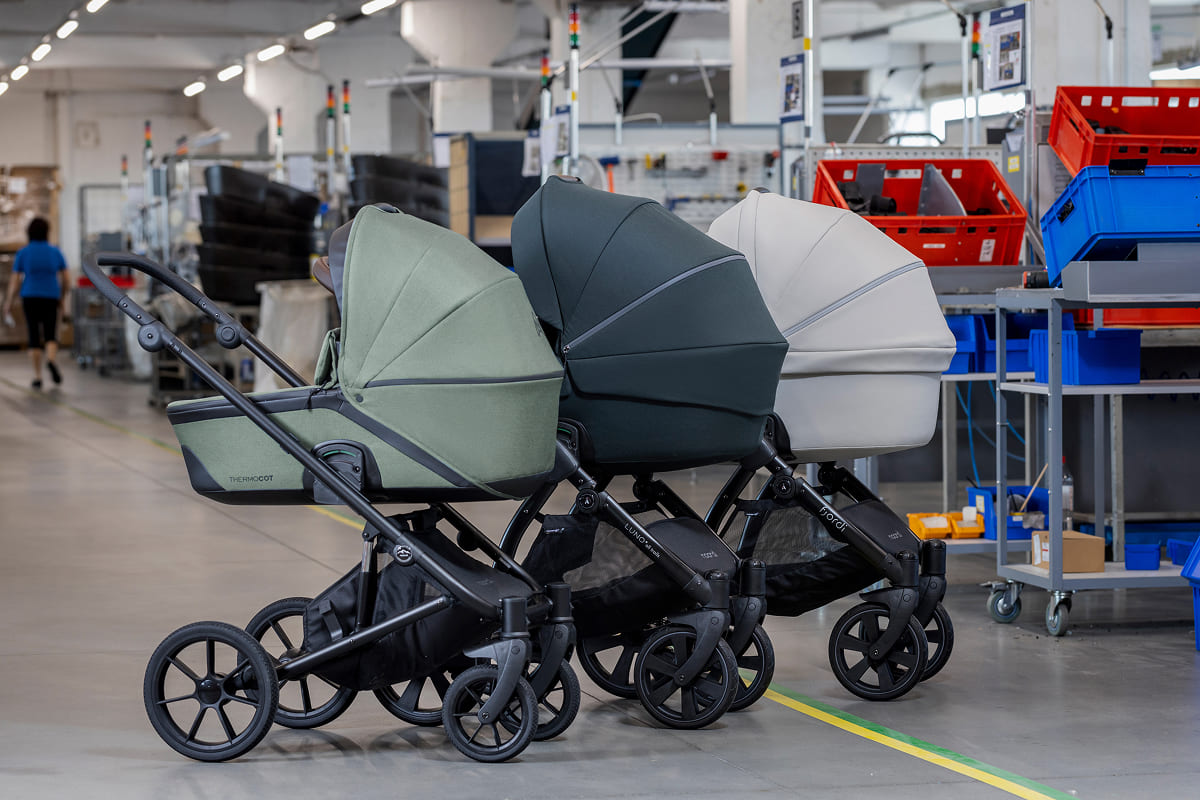
Noordi was founded in 2013. Fjordi V.2 and Aqua V.2 are built in our own factory in Kaunas: aluminium frames are cut, bent, welded and painted on the first floor, fabrics are sewn on the second, and every pram is assembled and tested on the third.
All the key numbers — founding year, models, prices and awards — are on our facts page.
Read also: The Scandinavian pram: what makes it Nordic, and how to choose one
Frequently asked questions
Are any prams still made in Europe?
Yes. Brands such as Noordi and Tutis (Lithuania) and Hartan (Germany) state that their prams are manufactured in the EU. Many others are designed in Europe and produced in Asia.
Where are Noordi prams made?
Fjordi V.2 and Aqua V.2 are made in Noordi’s own factory in Kaunas, Lithuania.
How can I find out where a pram is made?
Look for a “made in” statement on the product page, the box or the label, and ask the brand directly where the frame and fabrics are produced.
Is a pram made in Europe safer?
Not automatically. Safety comes from design and testing; look for EN 1888 regardless of where a pram is built.
Does “European brand” mean “made in Europe”?
No. A brand can be based in Europe and manufacture elsewhere. Check the production country separately.
Where a pram is made is one question among several — but it is a fair one to ask, and a good brand will answer it plainly.
Sources: Noordi facts, Tutis customer service, Hartan: about us, Utopia: nachhaltige Kinderwagen, Manufacturing Today: Bugaboo, Your Europe: guarantees. Checked October 2026.
Made for the way you wander.
Three strollers, one calm way of getting outside. Find the one that fits your family’s days.
More from the Journal

Where are Noordi prams made? Inside our factory in Kaunas, Lithuania
Noordi prams are made in Kaunas, Lithuania, in a factory that has been making prams since 1993. Here is what happens under one roof, from sketch to your door.

How a Noordi Pram Is Made: From Scottish Fields to Your Front Door
One path, one roof: how a Noordi pram is made, from fabrics chosen across Europe to our lab, three factory floors in Kaunas and the solar panels above.

Second-Hand or New Pram? What to Check Before You Buy
A second-hand pram can be a good choice – if you know what to check. Brakes, frame, locks, harness, recalls and the manual, plus when new is simply calmer.